
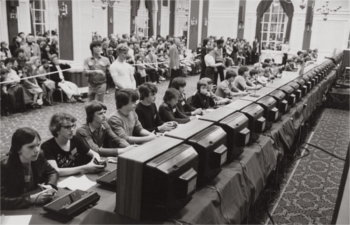
 Early history (1972–1989)
The earliest known video game competition took place on 19 October 1972 at Stanford University for the game Spacewar. Stanford students were invited to an “Intergalactic spacewar olympics” whose grand prize was a year’s subscription for Rolling Stone, with Bruce Baumgart winning the five-man-free-for-all tournament and Tovar and Robert E. Maas winning the Team Competition. The Space Invaders Championship held by Atari in 1980 was the earliest large scale video game competition, attracting more than 10,000 participants across the United States, establishing competitive gaming as a mainstream hobby.
In the summer of 1980, Walter Day founded a high score record keeping organization called Twin Galaxies. The organization went on to help promote video games and publicize its records through publications such as the Guinness Book of World Records, and in 1983 it created the U.S. National Video Game Team. The team was involved in competitions, such as running the Video Game Masters Tournament for Guinness World Records and sponsoring the North American Video Game Challenge tournament.
During the 1970s and 1980s, video game players and tournaments began being featured in well-circulated newspapers and popular magazines including Life and Time. One of the most well known classic arcade game players is Billy Mitchell, who was credited with the records for high scores in six games including Pac-Man and Donkey Kong in the 1985 issue of the Guinness Book of World Records. Some of those records would be removed in 2018 amid allegations of fraud.
Televised eSports events aired during this period included the American show Starcade which ran between 1982 and 1984 airing a total of 133 episodes, on which contestants would attempt to beat each other’s high scores on an arcade game. A video game tournament was included as part of TV show That’s Incredible!, and tournaments were also featured as part of the plot of various films, including 1982’s Tron. In the UK, the BBC game show First Class included competitive video game rounds featuring the contemporary arcade games Hyper Sports, 720° and Paperboy.
Online video games (1990–1999)
In the 1990s, many games benefited from increasing internet connectivity, especially PC games. For example, the 1988 game Netrek was an Internet game for up to 16 players, written almost entirely in cross-platform open source software. Netrek was the third Internet game, the first Internet game to use metaservers to locate open game servers, and the first to have persistent user information. In 1993 it was credited by Wired Magazine as “the first online sports game”. Large eSports tournaments in the 1990s include the 1990 Nintendo World Championships, which toured across the United States, and held its finals at Universal Studios Hollywoodin California. Nintendo held a 2nd World Championships in 1994 for the Super Nintendo Entertainment System called the Nintendo PowerFest ’94. There were 132 finalists that played in the finals in San Diego, California. Mike Iarossi took home 1st prize. Blockbuster Video also ran their own World Game Championships in the early 1990s, co-hosted by GamePro magazine. Citizens from the United States, Canada, the United Kingdom, Australia, and Chile were eligible to compete. Games from the 1994 championships included NBA Jam and Virtua Racing.
Television shows featuring eSports during this period included the British shows GamesMaster and Bad Influence! the Australian game show A*mazing, where in one round contestants competed in a video game face off, and the Canadian game show Video & Arcade Top 10.
Tournaments established in the late 1990s include the Cyberathlete Professional League (CPL), QuakeCon, and the Professional Gamers League. PC games played at the CPL included the Counter-Strike series, Quake series, and Warcraft.
Global tournaments (2000–present)
The growth of eSports in South Korea is thought to have been influenced by the mass building of broadband internet networks following the 1997 Asian financial crisis. It is also thought that the high unemployment rate at the time caused many people to look for things to do while out of work. Instrumental to this growth of eSports in South Korea was the prevalence of the Komany-style internet café/LAN gaming center, known as a PC bang. The Korean e-Sports Association, an arm of the Ministry of Culture, Sports and Tourism, was founded in 2000 to promote and regulate eSports in the country.
During the 2010s, eSports grew tremendously, incurring a large increase in both viewership and prize money. Although large tournaments were founded before the 21st century, the number and scope of tournaments has increased significantly, going from about 10 tournaments in 2000 to about 260 in 2010. Many successful tournaments were founded during this period, including the World Cyber Games, the Intel Extreme Masters, and Major League Gaming. The proliferation of tournaments included experimentation with competitions outside traditional eSports genres. For example, the September 2006 FUN Technologies Worldwide Webgames Championship featured 71 contestants competing in casual games for a $1 million grand prize.
In April 2006 the G7 teams federation were formed by seven prominent Counter-Strike teams. The goal of the organization was to increase stability in the eSports world, particularly in standardizing player transfers and working with leagues and organizations. The founding members were 4Kings, Fnatic, Made in Brazil, Mousesports, NiP, SK-Gaming, Team 3D. The organization only lasted until 2009 before dissolving.
The 2000s was a popular time for televised eSports. Television coverage was best established in South Korea, with StarCraft and Warcraft III competitions regularly televised by dedicated 24-hour cable TV game channels Ongamenet and MBCGame. Elsewhere, eSports television coverage was sporadic. The German GIGA Television covered eSports until its shutdown in 2009. The United Kingdom satellite television channel XLEAGUE.TV broadcast eSports competitions from 2007 to 2009. The online eSports only channel ESL TV briefly attempted a paid television model renamed GIGA II from June 2006 to autumn 2007. The French channel Game One broadcast eSports matches in a show called Arena Online for the Xfire Trophy. The United States channel ESPN hosted Madden NFL competitions in a show called Madden Nation from 2005 to 2008. DirecTV broadcast the Championship Gaming Series tournament for two seasons in 2007 and 2008. CBS aired prerecorded footage of the 2007 World Series of Video Games tournament that was held in Louisville, Kentucky. The G4 television channel originally covered video games exclusively, but broadened its scope to cover technology and men’s lifestyle, though has now shutdown.
The popularity and emergence of online streaming services have helped the growth of eSports in this period, and are the most common method of watching tournaments. Twitch, an online streaming platform launched in 2011, routinely streams popular eSports competitions. In 2013, viewers of the platform watched 12 billion minutes of video on the service, with the two most popular Twitch broadcasters being League of Legends and Dota 2. During one day of The International, Twitch recorded 4.5 million unique views, with each viewer watching for an average of two hours.
The modern eSports boom has also seen a rise in video games companies embracing the eSports potential of their products. After many years of ignoring and at times suppressing the eSports scene, Nintendo hosted Wii Games Summer 2010. Spanning over a month, the tournament had over 400,000 participants, making it the largest and most expansive tournament in the company’s history. In 2014 Nintendo hosted an invitational Super Smash Bros. for Wii U competitive tournament at the 2014 Electronic Entertainment Expo (E3) press conference that was streamed online on Twitch. Halo developers 343 Industries announced in 2014 plans to revive Halo as an eSport with the creation of the Halo Championship Series and a prize pool of $50,000 USD. Both Blizzard Entertainment and Riot Games have their own collegiate outreach programs with their North American Collegiate Championship.[48][49] Since 2013 universities and colleges in the United States such as Robert Morris University Illinois and the University of Pikeville have recognized eSports players as varsity level athletes and offer athletic scholarships. In 2017, Tespa, Blizzard Entertainment’s collegiate eSports division, unveiled its new initiative to provide scholarships and prizes for collegiate eSports clubs competing in its tournaments worth US$1 million. Colleges have began granting scholarships to students who qualify to play eSports professionally for the school. Colleges such as Columbia College, Robert Morris University, and Indiana Institute of Technology have taken part in this. In 2018, Harrisburg University of Science and Technology began a tuition scholarship program for eSports players.
In 2014, the largest independent eSports league, Electronic Sports League, partnered with the local brand Japan Competitive Gaming to try and grow eSports in the country.
Physical viewership of eSports competitions and the scope of events have increased in tandem with the growth of online viewership. In 2013, the Season 3 League of Legends World Championship was held in a sold-out Staples Center. The 2014 League of Legends World Championship in Seoul, South Korea, had over 40,000 fans in attendance and featured the band Imagine Dragons, and opening and closing ceremonies in addition to the competition.
In 2015, the first Esports Arena was launched in Santa Ana, California, as the United States’ first dedicated eSports facility. In 2018, the Luxor Las Vegas will open the first eSports Arena on the Las Vegas Strip and additional locations are planned to open in the coming decade.
Professional leagues
In most eSports, organized play is centered around the use of promotion and relegation to move sponsored teams between leagues within the competition’s organization based on how the team fared in matches; this follows patterns of professional sports in European and Asian countries. However, with rising interest in viewership of eSports, some companies sought to create leagues that followed the approach used in North American professional sports, in which all teams participate in a regular season of matches to vie for top standing as to participate in the post-season games. This approach is more attractive for larger investors, who would be more willing to back a team that remains playing in the eSport’s premiere league and not threatened to be relegated to a lower standing.
Blizzard Entertainment announced the Overwatch League, based on its Overwatch game, in 2016, with its inaugural regular season featuring twelve teams starting in January 2018. Players that get contracts to play on teams are guaranteed an annual salary and benefits, as well as sharing of the team’s revenue and prize winnings; the first season had a total prize pool of US$3.5 million available, with US$1 million to the team winning in post-season.
Take-Two Interactive partnered with the National Basketball Association (NBA) to create the NBA 2K League, using the NBA 2K game series. It is the first eSports league to be operated by a professional sports league, and the NBA sought to have a League team partially sponsored by each of the 30 professional NBA teams. Its inaugural season is set to start May 2018 with 17 teams. Similarly, EA Sports and Major League Soccer (MLS) established the eMLS, an eSport league using EA’s FIFA 18; in its inaugural season, 19 of the 23 MLS teams will manage teams for the eMLS.
 XCEED.